How to Check Your eKasih Status for BAeK PTPTN Eligibility

Jeremiah Thooyavan
September 18, 2026
Applying for BAeK PTPTN? Learn how to check your eKasih status, what to do if your name is missing, and how to update your details for PTPTN consideration.

The student's own name must be in the eKasih database, not just their parents'. Having a parent or Head of Household (Ketua Isi Rumah) registered does not automatically guarantee eligibility—students must verify using their own MyKad number on the official eKasih portal.
Missing or unregistered students must update/register through physical government channels. Registration or adding a missing student to an existing household record cannot be done online; it must be handled through ICU JPM State Offices, District Offices, or local community leaders (e.g., JPKK, MPP).
Being in eKasih does not grant BAeK automatically. Students whose eKasih status was added or updated must submit an appeal directly to PTPTN, and they must still satisfy additional criteria (e.g., full-time IPTA Diploma/Degree, under age 25, PTPTN financing approved from Jan 1, 2026 onwards).
If you are hoping to qualify for the Biasiswa Anak eKasih PTPTN (BAeK PTPTN), being part of the eKasih database is one of the key requirements.
But what if your parents are registered and you are not sure whether your own name appears? Or if your household is even registered under eKasih?
Here is what students should check before approaching PTPTN.
1. Why Does eKasih Matter for BAeK PTPTN?
BAeK PTPTN is available to eligible students from B40 households that are listed in the eKasih database.
For BAeK specifically, PTPTN states that the student must be listed in eKasih, alongside meeting other requirements such as studying full-time for a Diploma or Bachelor's Degree at an IPTA and having PTPTN financing approved from 1 January 2026 onwards.
This means having a parent or household member associated with eKasih does not automatically mean you should assume
that your own details are already recorded.
2. How Do You Check Whether You Are Already Registered?
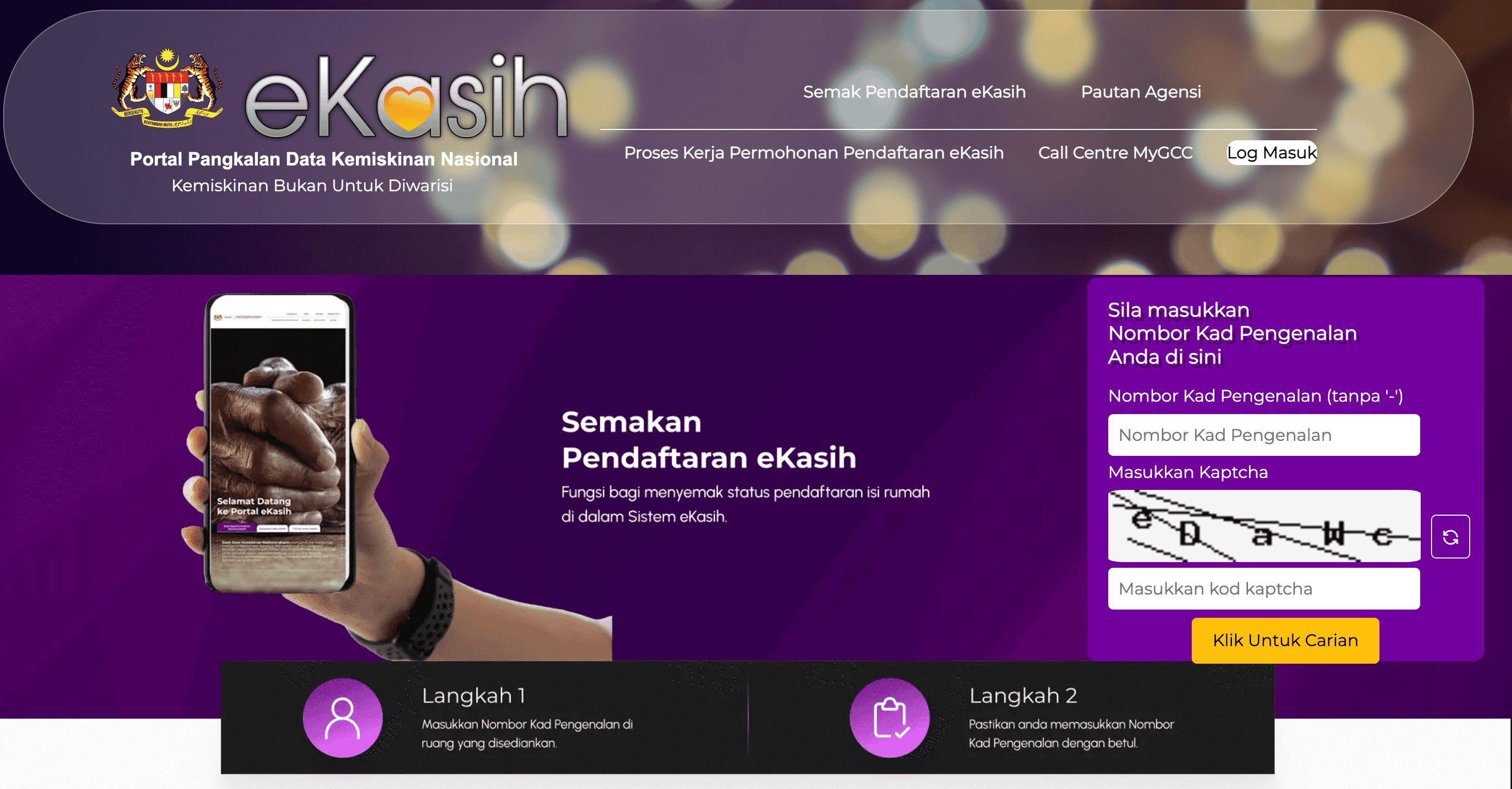
You can check your eKasih registration status online through the official government eKasih status-checking service.
The process is simple:
- Open the official eKasih status checker.
- Enter your MyKad number.
- Select the search option to view your registration status.
The service is free and the result is provided immediately.
For students checking BAeK eligibility, it is useful to check using your own MyKad number, because PTPTN requires the student to be listed in eKasih.
3. Does the Student or Head of Household Need to Be Registered?
eKasih is primarily a household-based poverty database, with household information usually organised around the Head of Household, or Ketua Isi Rumah (KIR).
However, BAeK PTPTN has an additional practical requirement: the student must appear in the eKasih database.
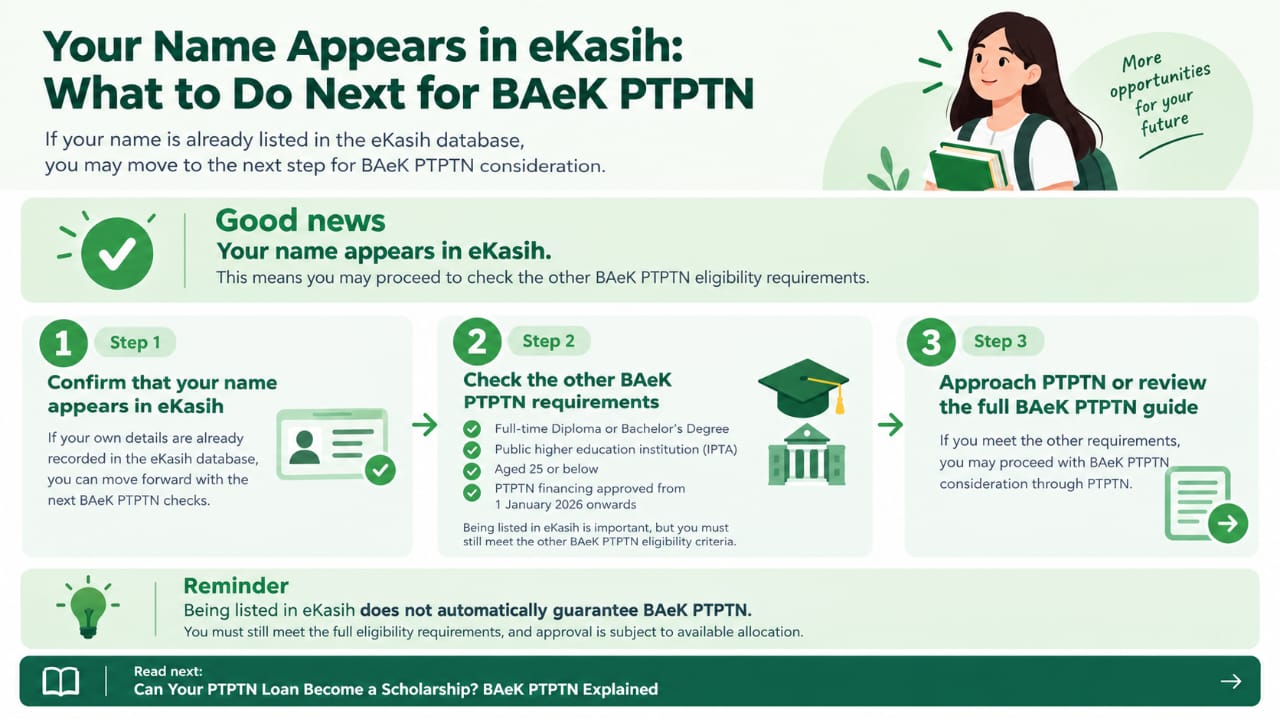
For example, if your father is the Head of Household and your family is registered under eKasih, do not simply assume your BAeK eligibility is confirmed. Check your own MyKad to see whether your details are reflected in the database.
4. What If Your Family is Registered but Your Name is Missing?
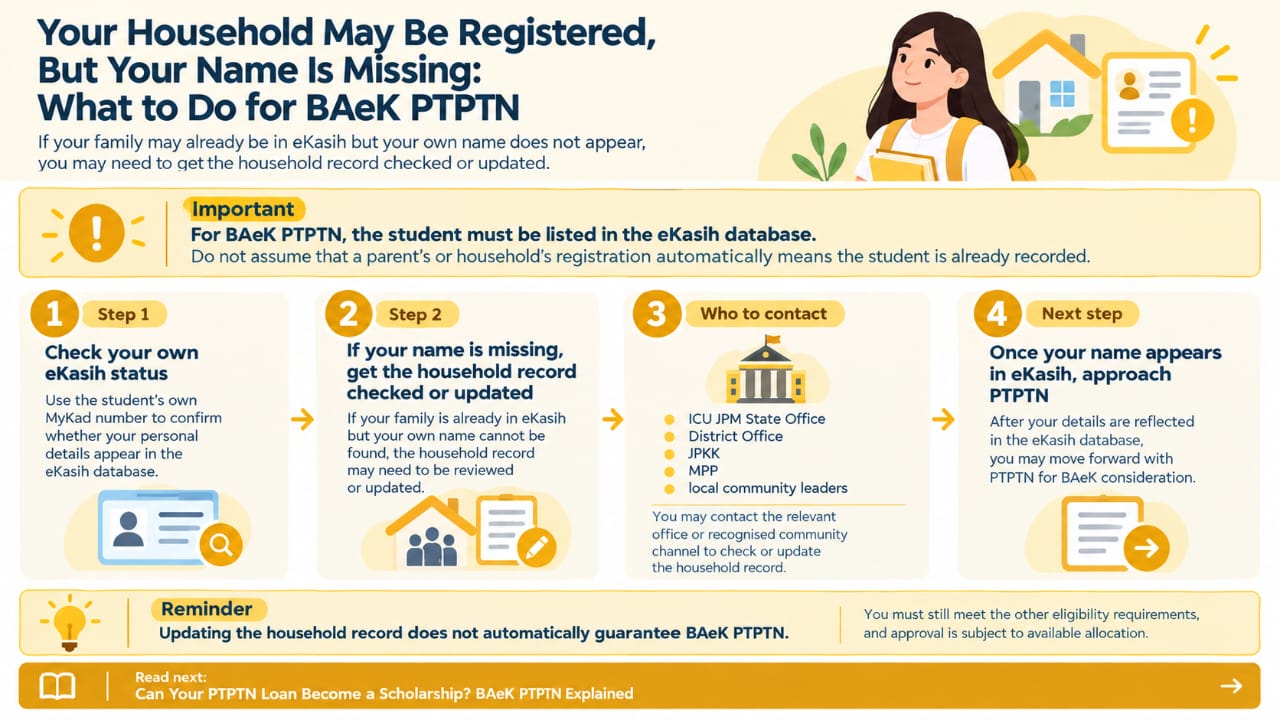
If your household is already in eKasih but your own details cannot be found, the next step should be to have the household record checked or updated.
The public eKasih guidance does not currently provide a dedicated online process for students to add themselves to an existing household record.
Registration and household matters are instead handled through recognised channels such as the relevant ICU JPM State Office, District Office, local community leaders, JPKK or MPP.
Students in this situation should contact the relevant office and explain that their household is already registered but that their own details need to be checked.
5. What If Your Household Is Not Registered With eKasih?
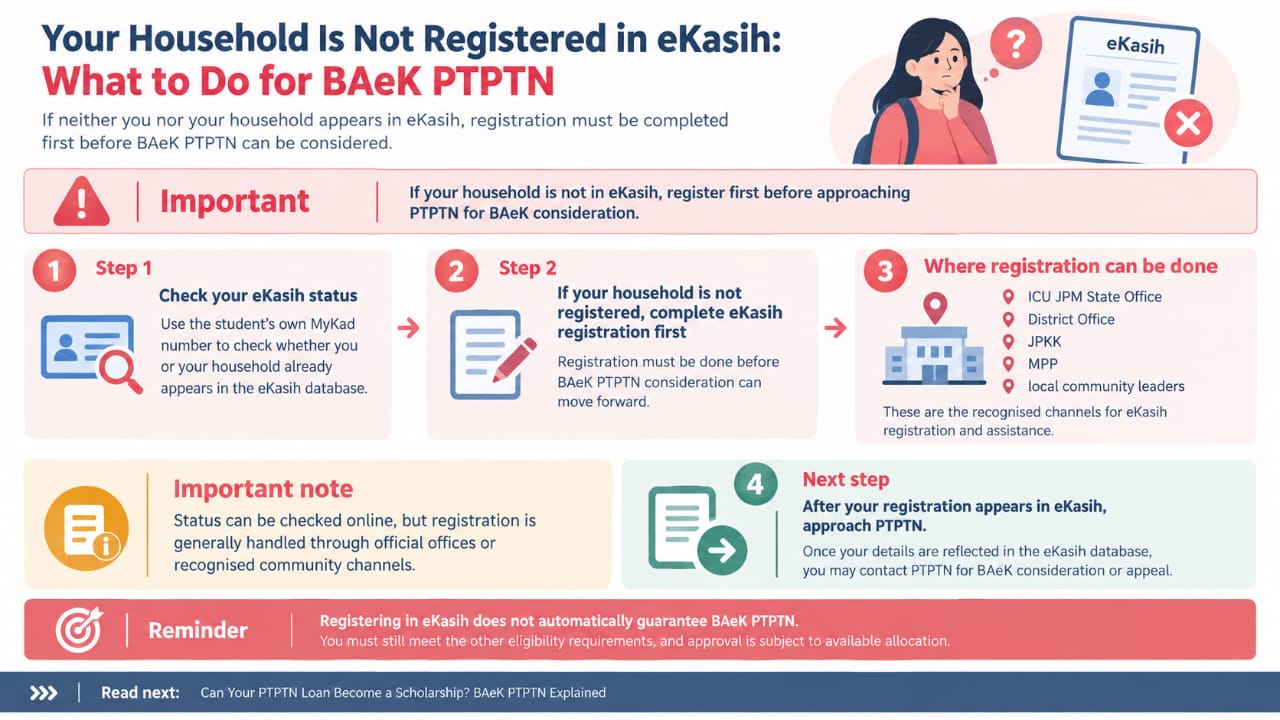
If neither you nor your household is registered, you will need to complete the eKasih registration process first.
Registration can be initiated through recognised government or community channels, including:
- ICU JPM State Offices
- District Offices
- local community leaders
- Village Development and Security Committees (JPKK)
- Residents' Representative Councils (MPP)
It is worth noting that while eKasih status can be checked online, the current government guidance does not describe a standard public online self-registration form.
6. What Happens Once Your eKasih Status Is Updated?
If your name was previously missing and later appears in eKasih, you do not automatically receive BAeK.
Instead, PTPTN states that students who were previously not in the database should appeal to PTPTN once they have been registered in eKasih.
Your BAeK eligibility will still depend on meeting the other conditions, including your course, institution, age and PTPTN financing approval date.
7. When Should You Approach PTPTN?
You should approach PTPTN for BAeK consideration after your eKasih registration has been recorded.
PTPTN specifically states that students whose names were previously absent from eKasih should register first and then submit an appeal to PTPTN. Any scholarship offer is still subject to available financial allocation.
PTPTN's current BAeK FAQ does not specify a dedicated online BAeK appeal form, so students should check directly with PTPTN for the appropriate appeal channel once their eKasih record has been updated.
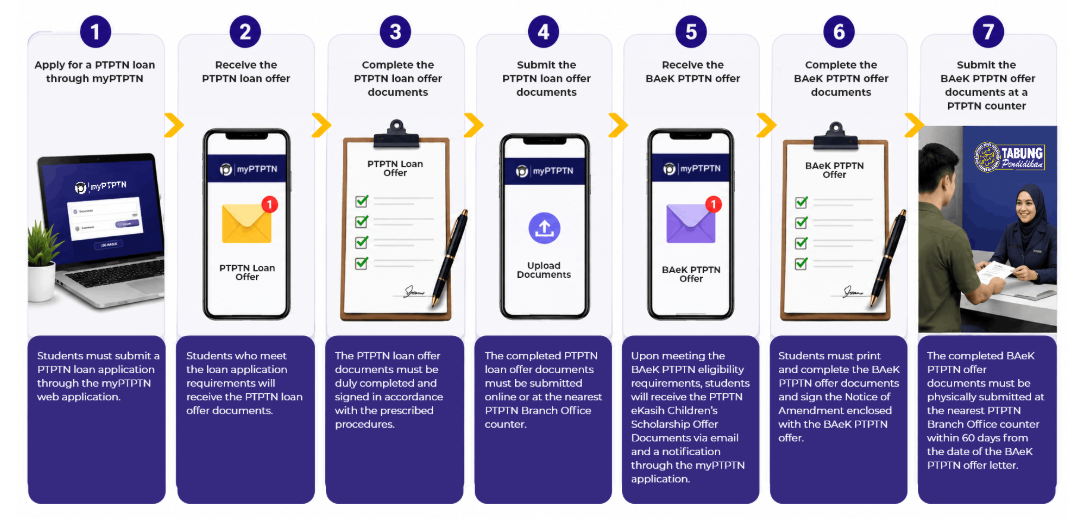
Before You Apply for BAeK
Being listed in eKasih is only one part of BAeK eligibility.
You must still meet the other requirements, including being aged 25 or below, studying a full-time Diploma or Bachelor's Degree at an IPTA, and having PTPTN financing approved from 1 January 2026 onwards.


Students
© 2009 - 2026 TIMES MEDIA SDN. BHD. (955976-P). All Rights Reserved.