5 Successful Malaysian Entrepreneurs Who Took Local Ideas Global

Jeremiah Thooyavan
November 10, 2026
Discover how Jimmy Choo, Tony Fernandes, Lim Wee Chai, Mark Chang and Marrybrown's founders turned different educational backgrounds into global success.
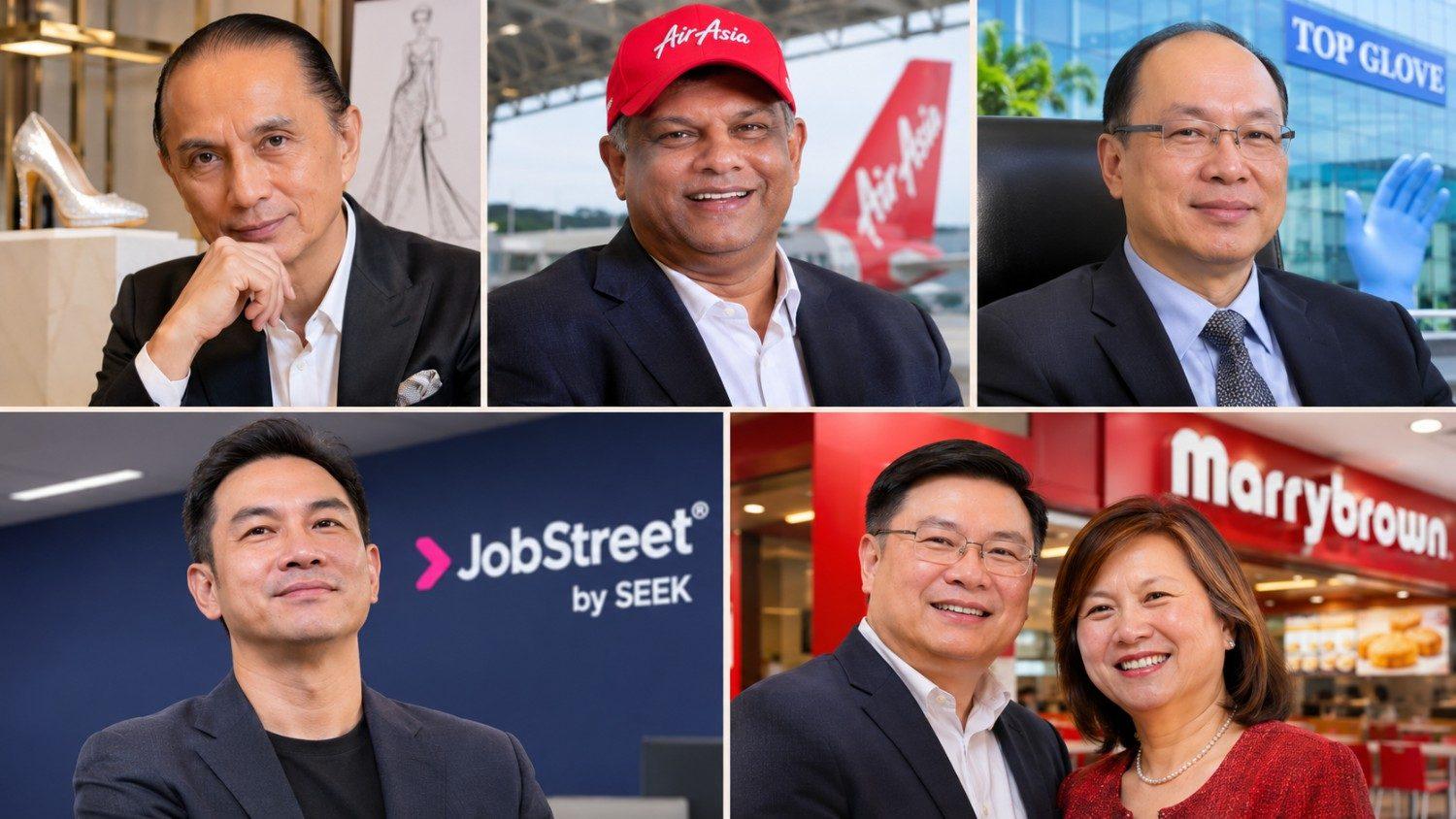
- Successful Malaysian entrepreneurs come from different educational backgrounds and career pathways. From Jimmy Choo's footwear design training to Tony Fernandes' accounting qualification and Mark Chang's engineering education, their stories show that there is no single academic route to building a successful business.
- Your university degree does not have to determine your future career. Tony Fernandes moved from accounting and music into aviation, while Mark Chang transitioned from engineering to online recruitment. Both used their experiences and transferable skills to build businesses in completely different industries.
- Building a global business often starts with a small idea and involves overcoming significant challenges. Top Glove began with one factory and production line, AirAsia was acquired for RM1 alongside substantial debt, and Marrybrown's founders faced rejected financing applications before expanding internationally.
- Entrepreneurial success depends on more than academic qualifications. While formal education can provide valuable knowledge and skills, Nancy Liew's journey from nursing to co-founding Marrybrown shows that practical experience, determination and the ability to recognise opportunities can also lead to international business success.
What do a Penang shoemaker, an accountant who bought an airline for RM1, and a nurse who couldn't afford university have in common?
They became successful Malaysian entrepreneurs whose businesses reached customers around the world. But their journeys were anything but straightforward.
Some followed their academic interests. Others changed industries completely. One never attended university.
Here are five stories that show how differently success can begin.
Five Malaysian Entrepreneurs at a Glance
Entrepreneur | Education / Background | Business |
Jimmy Choo | Footwear Design | Jimmy Choo |
Tony Fernandes | Accounting | AirAsia |
Lim Wee Chai | Physics, MBA | Top Glove |
Mark Chang | Mechanical Engineering | JobStreet |
Lawrence & Nancy Liew | Nursing background for Nancy | Marrybrown |
Jimmy Choo: The Shoemaker's Son Who Conquered Luxury Fashion
Before celebrities were wearing his shoes, Jimmy Choo was learning shoemaking from his father in Penang. He made his first pair at just 11.
He later studied footwear design at London's Cordwainers College, graduating in 1983.
His breakthrough came when Vogue featured his designs in 1988. Princess Diana became one of his famous clients.
In 1996, Choo co-founded the Jimmy Choo brand with Tamara Mellon. But here's something you might not know: he sold his stake in 2001.
Today, the international brand belongs to Capri Holdings, while Choo has continued pursuing his own couture work.
Lesson: Mastering a skill can take you further than you imagine.
Tony Fernandes: The Accountant Who Bought AirAsia for RM1
Tony Fernandes studied at the London School of Economics and qualified as an accountant in 1991.
But instead of remaining in accounting, he joined the music industry, eventually becoming a senior executive at Warner Music.
Then came his biggest career change.
In 2001, Fernandes and his partners, including Kamarudin Meranun, acquired struggling airline AirAsia for just RM1, taking on approximately RM40 million in debt.
They transformed it into a low-cost airline that expanded across Asia.
Today, Fernandes leads Capital A, whose businesses include logistics, engineering and digital travel services.
Lesson: Your degree doesn't have to determine your industry.
Lim Wee Chai: From Physics Graduate to Top Glove Founder
What does a Physics degree have to do with rubber gloves?
For Lim Wee Chai, quite a lot.
He graduated from Universiti Malaya with a Physics degree in 1982 and later earned an MBA from Sul Ross State University in Texas.
After working in sales, he co-founded Top Glove with his wife, Tong Siew Bee, in 1991.
The company started with one factory and one production line before becoming a major international glove manufacturer.
Growth also brought challenges. US authorities restricted Top Glove imports over forced-labour concerns. The restrictions were lifted in September 2021 following remediation measures, including repayments to affected workers.
Lim remains associated with Top Glove as its founder and executive chairman.
Lesson: Scientific knowledge and commercial experience can complement each other.
Mark Chang: The Engineer Who Built JobStreet
Mark Chang studied Mechanical Engineering at the University of Texas before earning a master's degree from MIT.
He began as a process engineer at Kendall International but eventually moved into sales and marketing.
In 1997, he founded JobStreet, when online recruitment was still relatively new in Malaysia.
The company survived the dot-com crash and expanded across Southeast Asia.
In 2014, SEEK acquired JobStreet in a deal totalling approximately RM1.89 billion.
Today, Chang supports entrepreneurs through investments and mentoring, including his work with JCBNext and Endeavor Malaysia.
Lesson: Changing career paths doesn't mean wasting your education.
Lawrence and Nancy Liew: Building Marrybrown Without a University Degree
Nancy Liew performed well in school but couldn't afford university. Instead, she trained as a nurse and worked for six years.
In 1981, she and her husband Lawrence opened Marrybrown in Johor Bahru.
Their applications for bank financing were rejected. But they continued, developing a halal fast-food business incorporating Malaysian flavours.
Today, Marrybrown has more than 500 outlets across 16 countries.
Lesson: A lack of formal qualifications doesn't mean a lack of potential.
What Can Students Learn From These Entrepreneurs?
Their stories offer three lessons: develop useful skills, stay open to unexpected career opportunities, and learn how to turn knowledge into action.
A degree can provide a strong foundation, but success rarely follows one fixed route.
Students can explore different pathways through Afterschool's course guides and scholarship listings.
Your first qualification doesn't have to define your final destination.


Students
© 2009 - 2026 TIMES MEDIA SDN. BHD. (955976-P). All Rights Reserved.